

The most common question asked when purchasing a pump for an explosive atmosphere is: “Does it have ATEX certification?” This question alone guarantees almost nothing. This is because ATEX is not just a label—it’s a matching issue: the machine’s marking must correspond to your site’s zone, gas group, and ignition temperature.
An "ATEX-certified" pump is unsuitable if installed in the wrong zone. This guide covers reading the markings in the proposal line by line, documenting the requirements for your own site, and addressing ignition sources specific to pumps—which are often overlooked in most specifications.
Two directives, two separate responsibilities
This is often the source of the confusion. ATEX is not a single document, but rather two complementary regulations:
- 2014/34/EU — Equipment Directive. It regulates equipment and protective systems placed on the market for use in explosive atmospheres. The manufacturer is responsible. Its scope includes not only the machine itself but also safety, control, and regulation devices that contribute to the safe operation of the equipment, even if they are located outside the explosive atmosphere.
- 1999/92/EC — Workplace Directive. It establishes minimum requirements for the protection of workers exposed to the risk of explosive atmospheres. The employer is responsible; this includes classifying the area.
The practical result is this: the zone is not determined by the supplier, but by the business. The supplier simply provides the machine with the appropriate marking for the specified zone. The phrase “Whatever you recommend is fine” doesn’t apply here—the right machine cannot be selected without knowing the zone.
What does "zone" mean?
The zone indicates how frequently and for how long an explosive atmosphere is present. It is defined separately for gas and dust:
| Gas | Dust | Presence of an explosive atmosphere |
|---|---|---|
| Zone 0 | Zone 20 | Present continuously, for long periods, or frequently |
| Zone 1 | Zone 21 | Likely to occur occasionally during normal operation |
| Zone 2 | Zone 22 | Not expected during normal operation; if it occurs, it is brief |
One detail to note: the interior and exterior of a pump may be in different zones. If there is a continuous vapor phase within the liquid, the interior of the pump casing is considered Zone 0, while the machine room may be Zone 1. The slash in the marking (as we’ll see below) indicates exactly this.
Category and region equivalents
Directive 2014/34/EU classifies equipment into groups and categories. Group I is for mining; Group II is for surface industry—pumps and blowers fall into this group. The category, on the other hand, indicates the level of protection and corresponds to the zone:
| Category | Gas region | Dust Zone | Protection Level (EPL) |
|---|---|---|---|
| 1 | Zone 0 | Zone 20 | Ga / Da — very high |
| 2 | Zone 1 | Zone 21 | Gb / Db — high |
| 3 | Zone 2 | Zone 22 | Gc/Dc — normal |
The rule applies in one direction only: a higher-category machine can be used in a lower-category zone, but not vice versa. A Category 2 machine operates in Zone 2; a Category 3 machine cannot be placed in Zone 1.
Reading the markup line by line
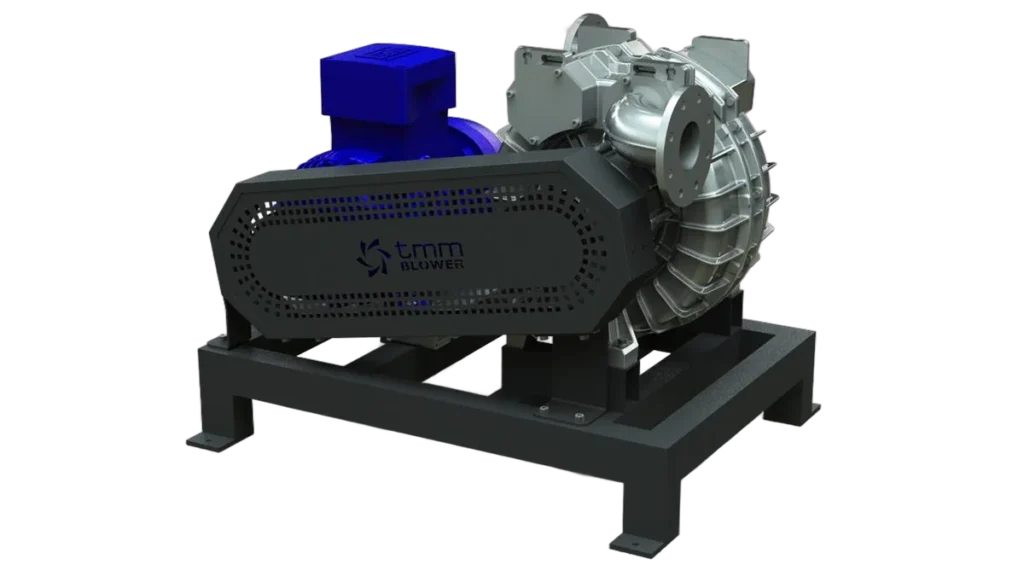
Let’s set theory aside and take a look at an actual label. The markings on the ATEX blower series we offer are as follows:
II 1/2G Ex h IIA T3 Ga/Gb
II 2D  Ex h IIIA T200 °C Db
The first line is for gas, the second line is for powder. Piece by piece:
| Symbol | Meaning |
|---|---|
| II | Equipment Group II — surface industry (excluding mining) |
| 1/2 | One side is Category 1, the other side is Category 2. The machine separates the two zones: the inner side faces Zone 0, and the outer side faces Zone 1 |
| G | Gas atmosphere (D would indicate dust) |
| Ex h | Non-electrical equipment protection — ISO 80079-36 requires such equipment to be marked with an "h" |
| IIA | Gas group IIA (propane/butane class). IIB and IIC are more challenging |
| T3 | Temperature class: maximum surface temperature 200 °C |
| Ga/Gb | Protection level: one side very high (Zone 0), the other side high (Zone 1) |
| IIIA | Dust group IIIA — flammable airborne fibers |
| T200 °C | Instead of the dust temperature class, the actual maximum surface temperature is specified |
| Db | Dust-side protection level — Zone 21 |
When you read this label, you can say without hesitation where the machine can be placed. Do the same for every line in your proposal—the phrase "ATEX-certified" does not substitute for these lines.
Group: IIA, IIB, IIC
The gas group indicates how easily the mixture ignites and how easily it supports a flame. The difficulty increases from IIA to IIC:
- IIA: acetic acid, acetone, ammonia, butane, methane (non-mining natural gas)
- IIB: diethyl ether, ethylene, ethanol, methyl ethyl ketone (MEK)
- IIC: acetylene, hydrogen — the most challenging group
The rule is once again one-way: Equipment certified for IIC can also be used in IIB and IIA, but not vice versa. If there is hydrogen on your site, a machine marked IIA is not suitable—regardless of its capacity.
This is the line that’s most often overlooked when comparing quotes: two machines have the same flow rate and belong to the same category, but one is IIA and the other is IIC, and that’s where the price difference comes from.
Temperature class: How is T3 selected?
The temperature class is an upper limit set for the maximum surface temperature of the equipment. The correct class is selected based on the ignition temperature of the gas at your site: under no circumstances should the equipment’s surface reach that temperature.
| Class | Maximum surface temperature |
|---|---|
| T1 | 450 °C |
| T2 | 300 °C |
| T3 | 200 °C |
| T4 | 135 °C |
The series continues with T5 and T6 for lower limits; the exact values are specified in IEC 60079-0. As the number increases, the limit decreases—that is, T4 represents a more stringent requirement than T3. This reverse logic is often misunderstood when reading the standard.
When pumping hot fluids, this limit also requires special attention: the fluid itself determines the casing temperature. Transporting a product at 200 °C using a T3 (200 °C) class machine means operating right at the limit. We’ve covered the hot service side in our hot oil pump guide.
"What is 'Ex h'?" Mechanical equipment also has an ignition source
A common misconception is that ATEX applies only to electrical equipment. In fact, a rotating pump is a source of ignition in its own right because it can generate friction and hot surfaces.
ISO 80079-36 specifies the methods for the design, manufacture, testing, and marking of non-electrical equipment with its own potential ignition source and requires that such equipment be marked with an "h." ISO 80079-37, on the other hand, defines the types of protection: structural safety "c," control of the ignition source "b," and immersion in liquid "k."
The EN 13463 series was used in older specifications; this series has been withdrawn and replaced by ISO 80079. If you have an old specification, you need to update it—just as ISO 10816 has been replaced by ISO 20816 for vibration (failure and maintenance guide).
Pump-specific ignition sources
This is the section most often overlooked in the specifications. Even a certified machine can become a source of ignition if operated incorrectly. The main ones for pumps are:
- Dry running. The fluid both lubricates and cools the rotating surfaces. When the fluid runs dry, frictional heat rises rapidly, and the surface temperature may exceed the T class. For this reason, dry-run protection in ATEX installations is not a convenience feature but a requirement for compliance.
- Decoupling in the magnetic coupling. In sealless pumps, if the magnets lose synchronization under excessive load, eddy currents in the containment shell generate heat. The temperature rises very quickly. We have explained the mechanism in detail in our guide to magnetic drive pumps; in ATEX installations, this is a risk that must be monitored.
- Bearing failure. A failing bearing creates a local hot spot. Alignment and vibration monitoring are safety concerns here—not just a matter of service life.
- Static electricity. Charges accumulate in non-conductive plastic casings and hoses. Grounding and the selection of conductive materials are essential; we address the material selection aspect in our material selection guide.
- Operation with a closed line. Energy supplied when there is no flow is converted to heat, causing the casing temperature to rise. The safety valve and minimum flow rate requirement take on additional importance in ATEX installations.
- Cavitation and foreign objects. Metal-to-metal contact can produce sparks. Proper installation of the suction line (NPSH guide) and the use of a strainer reduce this risk.
Is an air-driven pump inherently safe?
Short answer: No. Air-operated double-diaphragm pumps do not have an electric motor, and this is a real advantage—it eliminates the need for an electrical ignition source and simplifies installation. However, the machine is still a mechanical ignition source and is not exempt from ATEX regulations.
Points to consider for air-driven pumps: the conductivity of the casing and internal components (static charge buildup), ensuring that the grounding connection is properly installed, protection against dry running, and protection against foreign objects. You can find the pump’s selection criteria in our AODD selection guide.
The same logic applies to blowers: Exceeding the pressure differential limit described in our blower guide can cause not only equipment damage but also surface temperature issues in an ATEX installation.
Nonconformity → cause → initial inspection
| Situation | Cause | Initial inspection |
|---|---|---|
| "ATEX-certified" machine found non-compliant during inspection | The category does not match the zone classification | Zone classification vs. category/EPL on the label |
| Significant price difference between two bids for the same capacity | Gas group is different (IIA ↔ IIC) | Gas group on the label vs. gas group at the site |
| Machine surface is hotter than expected | Operation in a closed line or at very low flow rate | Safety valve, minimum flow rate, discharge valve |
| Sudden overheating in a sealless pump | Decoupling — eddy current heat | Overload protection; viscosity and density |
| Sparking or a shock sensation in a plastic casing of a pump | Static charge buildup | Grounding connection; choice of conductive material |
| Old specification does not match the new product | Specification refers to EN 13463 | Update to ISO 80079-36 / -37 |
| Certification exists, but the temperature class is disputed | Fluid temperature is close to the T class | The difference between the process temperature and Class T |
Purchasing Checklist
- Zone: Is the zone of the location where the machine will be installed specified? (Gas 0/1/2, Dust 20/21/22)
- Are the internal and external zones separate? If the pump separates the two zones, a slash is expected in the marking.
- Gas group: Has the group of the fluid on-site (IIA/IIB/IIC) been determined?
- Ignition temperature: Is the gas’s auto-ignition temperature known? Was the T-class selected accordingly?
- Process temperature factor: Is there a correlation between the fluid temperature and the T-class?
- If dust is present, is there a separate designation (D, III, maximum surface temperature)?
- Is dry running protection included in the proposal?
- Are grounding and conductive materials required?
- Documentation: Are the declaration of conformity and operating instructions included in the delivery?
- Is the reference to the standard up to date (ISO 80079-36/-37, not EN 13463)?
Frequently Asked Questions
Are explosion-proof pumps and ATEX pumps the same thing?
They are used interchangeably in everyday language but are technically different. "Exproof" (flameproof) is a type of protection used in electrical equipment. ATEX, on the other hand, is the name of a European regulation and also covers non-electrical equipment. A pump may be “ATEX-compliant” and contain an exproof motor; the two are not the same thing.
Who determines the region?
Employer. The 1999/92/EC Workplace Directive places the responsibility for zone classification on the employer. The supplier provides equipment with markings appropriate for the designated zone. Therefore, you must provide the zone information when requesting a quote—the supplier cannot guess this on your behalf.
Can I use a Category 2 machine in Zone 2?
Yes. The rule is one-way: a higher category can be used in a lower-risk zone. A Category 2 machine (for Zone 1) will operate without issue in Zone 2. The reverse is not true—a Category 3 machine cannot be placed in Zone 1.
Which is more challenging, T3 or T4?
T4 is more demanding. As the temperature class number increases, the maximum allowable surface temperature decreases: 200 °C for T3 and 135 °C for T4. The correct class is selected based on the ignition temperature of the gas at your site.
Is an air-operated double-diaphragm pump excluded from the scope of ATEX?
No. The absence of an electric motor is a significant advantage, but the machine can mechanically generate ignition sources: friction, dry running, foreign objects, and—especially in plastic casings—static charge. ISO 80079-36 is specifically intended for this type of non-electrical equipment and requires the “h” marking.
What does the "1/2" in the notation mean?
This indicates that the two sides of the machine fall into different categories: one side is Category 1 (Zone 0), and the other side is Category 2 (Zone 1). This is typical for pumps and blowers—the internal volume in contact with the fluid and the area where the machine is located may be in different zones.
Is the certificate sufficient?
Certification is required but is not sufficient on its own. Compliance is determined by the marking matching your facility’s zone, gas/dust group, and ignition temperature. Installation and operating conditions are also part of compliance: even a certified machine poses a risk if dry running protection, grounding, and the minimum flow rate requirement are not met.
Summary
ATEX is not a label; it is a classification. To select the correct machine, the company must provide three pieces of information: the zone (0/1/2 or 20/21/22), the gas or dust group (IIA/IIB/IIC), and the ignition temperature of the fluid. Each symbol on the label corresponds to one of these three criteria; the term “ATEX-compliant” does not correspond to any of them.
There is also one fact that is most often overlooked in specifications: even a certified machine can be a source of ignition if operated incorrectly. Dry running protection, grounding, minimum flow rate, and vibration monitoring are all part of safety in an ATEX installation.
If you provide us with your application, fluid, and ignition temperature, we can work together to identify the machine with the appropriate certification. You can review our ATEX blowers, magnetically driven sealless pumps, and air-operated double-diaphragm pumps, or get in touch with us for technical support.