

A wastewater treatment plant is not a single machine, but a chain of interconnected processes. The pump that draws in raw wastewater and the pump that feeds sludge into the dewatering process share the same name but are not related: one must pass fibrous solids through without clogging, while the other must force a substance with a nearly paste-like consistency under high pressure.
This guide takes you through the facility step by step, explaining why each piece of equipment was chosen at each stage. The goal is not to provide a list of brands, but to clarify what information you need to provide when requesting a quote.
Standard Framework of the Facility
Wastewater treatment plants in Europe are defined by the EN 12255 series. The series consists of 16 parts and covers plants with a total population equivalent of more than 50. The parts follow the plant’s flow diagram almost exactly:
- Chapter 1 — General Design Principles · Chapter 2 — Performance Requirements for Raw Wastewater Pumping Stations
- Chapter 3 — Pretreatment · Chapter 4 — Primary Settling · Chapter 5 — Lagoon Processes
- Chapter 6 — Activated Sludge Process · Chapter 7 — Biological Fixed-Film Reactors
- Chapter 8 — Sludge Treatment and Storage · Chapter 9 — Odor Control and Aeration
- Chapter 10 — Safety Principles · Chapter 11 — Required General Data · Chapter 12 — Control and Automation
- Chapter 13 — Chemical Treatment (Precipitation/Flocculation) · Chapter 14 — Disinfection
- Chapter 15 — Measurement of Oxygen Transfer in Clean Water in Aeration Tanks · Chapter 16 — Physical (Mechanical) Filtration
Using these numbers when drafting a specification cuts the debate short from the start: saying “a pumping installation covered by EN 12255-2” rather than “a lift pump” guarantees that both parties are describing the same scope.
Raw wastewater pumping: preventing clogs is the top priority
The first link in the chain is the lift pump that draws raw wastewater into the facility (EN 12255-2). The liquid here is not clean: it contains solids and fibrous particles. Wet wipes, textile fibers, and similar materials can quickly clog an impeller selected for high efficiency.
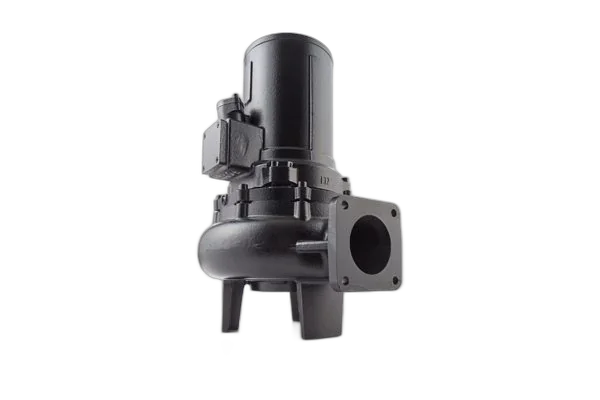
For this reason, impeller selection takes precedence over efficiency when it comes to upgrading. Our submersible wastewater series addresses this with three options: closed, semi-open, or vortex (free-flow) impellers. The vortex impeller transports the fluid using a vortex created inside the casing without direct contact with the impeller; it has the lowest efficiency but does not clog with fibrous material. We discussed the trade-offs among the three classic impeller types in our centrifugal pump impeller guide; the vortex impeller is the fourth member of this family, specifically designed for wastewater.
The series’ data sheet indicates the scope of the application: DN 50–DN 300 discharge flange, flow rates up to 1,600 m³/h, head up to 95 m, 40 °C, and a casing pressure of 10 bar. The definition of the pumpable fluids directly describes this class: industrial and domestic raw wastewater, as well as fluids containing solids and fibrous particles.
Because the flow rate is intermittent in the lift pit, the pump frequently starts and stops. If this is not taken into account in the calculations, the motor will be thermally overloaded; you can find the calculation for the required head in our TDH and system curve guide.
Ventilation: the facility’s largest energy expense
In the activated sludge process (EN 12255-6), the oxygen demand of the bacteria is met by blowers. This is the largest single energy expense in a typical facility—therefore, a mistake in selection is most costly here.
The primary factor determining the required pressure is the water head above the diffuser: each meter corresponds to approximately 98.1 mbar of counterpressure. Added to this are the diffuser’s own head loss, as well as losses in the piping and the suction line. The critical issue is that these factors increase over time: as the diffuser becomes dirty and the filter clogs, the blower’s pressure climbs toward its maximum continuous pressure.
The oxygen transfer performance of aeration systems is measured in clean water in accordance with EN 12255-15; the values obtained in actual wastewater are lower than this. For this reason, the air flow rate derived from the process calculation does not directly correspond to the catalog values—it is necessary to verify the reference condition (whether it is m³/h or Nm³/h).
When selecting a machine, the decision depends on the magnitude and stability of the back pressure: since pressure levels and contamination levels fluctuate constantly during treatment, a positive-displacement lobe blower is typically chosen. We’ve provided a detailed comparison in our blower selection guide; for product information, please see our lobe blower lineup.
Chemical dosing: the right dosing pump, the right control
Chemical treatment (EN 12255-13) is carried out through sedimentation and flocculation; the dosing of coagulants, polyelectrolytes, acids, and bases comes into play here. Each chemical presents a different dosing challenge:
- Coagulant (iron/aluminum salts): corrosive; material selection is critical.
- Polyelectrolyte: viscous and sensitive to shear stress; requires a preparation unit and gentle handling.
- Sodium hypochlorite: releases gas; causes a gas lock in the dosing pump.
- Acid/base: pH adjustment; depends on the measurement and control loop.
Pump type selection (solenoid dosing pump, mechanical diaphragm pump, peristaltic pump), back pressure and siphoning issues, calibration, and the hypochlorite gas lock case are covered in detail in our dosing pump selection guide. See our material selection guide for material compatibility—the wrong gasket in the coagulant line means a leak within weeks.
Closed-loop dosing falls under the category of control and automation (EN 12255-12): pH and redox measurement, flow rate-proportional dosing, and alarm logic. Our dosing pumps and control equipment group offers pumps, sensors, and control devices as a complete package.
Sludge: The dry matter content determines the pump type
This is the area where the most errors occur at the facility. In systems covered by the sludge treatment and storage standard (EN 12255-8), there is no single category labeled "sludge pump"; the determining factor is the sludge’s dry matter content.
As the solid content increases, the sludge ceases to behave like water. It ceases to be Newtonian: its viscosity varies with shear rate, and a certain stress is required for it to begin flowing. A centrifugal pump loses its effectiveness at this point—its flow rate drops, it clogs, and it converts energy into heat.
| The Condition of the Sludge | Behavior | Suitable family |
|---|---|---|
| Diluted (backflow, pre-concentrator) | Close to water | Submersible / centrifugal |
| Concentrated | Non-Newtonian, viscous | Positive displacement (progressing cavity pump, lobe) |
| Dehydration feed | High viscosity, yield stress | Progressing cavity pump; special selection required if high pressure is needed |
| Intermittent / abrasive, risk of dry running | Pulsating, abrasive | Air-operated diaphragm (AODD) |
The transition limits vary depending on the type of sludge; sludge rheology data is required for the design—the “percentage of solids” alone is not sufficient, as two slurries with the same percentage may behave differently. We discuss the rationale behind pump selection for viscous fluids in our guide to viscous fluid transfer; on the product side, progressing cavity pumps are the classic solution for this stage.
With a progressing cavity pump, two rules can prove costly: do not run it dry (the stator will be damaged within seconds) and do not operate it with the discharge line blocked (in a positive-displacement pump, the pressure will rise indefinitely). In dense and abrasive sludge applications, air-operated double-diaphragm pumps—which can tolerate dry running and are self-priming—are also considered.
Disinfection and Discharge
The disinfection of effluent is covered by EN 12255-14. In chlorine-based disinfection, the dosing pump, measurement probe, and control device operate together; the outgassing behavior of hypochlorite causes the same problem here as well.
If physical filtration is required prior to discharge (EN 12255-16), the filter feed pump is calculated as a separate item—since the back pressure increases as the filter becomes clogged, the system curve becomes steeper over time.
Safety: An Overlooked Explosive Atmosphere
Safety principles are covered by EN 12255-10 and have a direct impact on pump selection: biological decomposition in enclosed spaces produces flammable gases. For this reason, the pump pit, sludge tank, and the area surrounding the digester may be classified as hazardous zones.
If the zone has been specified, the equipment’s marking must correspond to that zone. We’ve covered how to interpret the markings and the ignition sources specific to pumps in detail in our ATEX and explosion-proof pump guide. Odor control and ventilation, however, are covered in a separate section (EN 12255-9).
Level → Equipment Summary
| Grade | EN 12255 | Equipment | Determining criterion |
|---|---|---|---|
| Raw wastewater pumping | Section 2 | Submersible centrifugal pump (vortex / semi-open impeller) | Fibrous solids — clog-free |
| Pretreatment | Section 3 | Screen, sand trap equipment | Solid size |
| Aeration | Sections 6, 15 | Lobe blower + diffuser | Immersion depth, oxygen demand |
| Chemical dosing | Section 13 | Dosing pump + sensor + control | Chemical type, material compatibility |
| Sludge transfer | Section 8 | Progressing cavity pump / lobe / AODD | Dry matter and rheology |
| Disinfection | Chapter 14 | Dosing pump + Measurement | Residue target |
| Automation | Section 12 | Sensor, control device | Closed-loop logic |
| Safety | Section 10 | ATEX-marked equipment (if required) | Zone classification |
Symptom → cause → initial examination
| Symptom | Possible cause | Initial Check |
|---|---|---|
| The booster pump clogs frequently | Impeller type is not suitable for fibrous solids | Vortex / semi-open impeller option |
| Aeration energy has increased, but discharge remains the same | Diffuser is dirty — back pressure has increased | Blower discharge pressure gauge; diffuser maintenance |
| Blower casing is overheating | Pressure differential exceeds maximum continuous value | Intake filter and diffuser resistance |
| Sludge pump flow rate has decreased | Dry matter has increased; pump type is insufficient | Sludge rheology; transition to the PD series |
| The progressing cavity pump failed shortly after installation | Dry running or pumping into a closed discharge line | Dry running protection; safety valve |
| The dosing pump is not pumping; there is noise | Hypochlorite gas lock | Gas relief valve; suction line configuration |
| Leak in the chemical line | Gasket/casing material is not compatible with the chemical | Compatibility chart; elastomer selection |
| Fluctuating output quality | Dosing is not in a closed loop or the probe is not calibrated | Measurement probe calibration; control logic |
Information to Provide When Requesting a Quote
- Plant capacity: equivalent population or daily flow rate, and intraday variations in flow rate.
- Stage: At which point is equipment required (pumping, aeration, dosing, sludge)?
- For pumping: solid particle size and fiber content, sump depth, and pumping frequency.
- For aeration: diffuser immersion depth, oxygen demand, altitude, and design air temperature; flow rate unit (m³/h vs. Nm³/h).
- For dosing: chemical name and concentration, flow rate range, back pressure, and control method.
- For sludge: dry matter content and rheological data, abrasiveness, distance, and elevation difference.
- Safety: Has the area been classified? If so, specify the zone and gas group.
- Materials: Required material class for parts in contact with the medium.
Frequently Asked Questions
What type of pump is used in a wastewater treatment plant?
There is no single answer; it depends on the stage. For raw wastewater lift, a clog-resistant submersible centrifugal pump is used; for aeration, a blower; for chemical dosing, a dosing pump; and for sludge transfer, depending on the solids content, a progressing cavity pump, a lobe pump, or an air-operated double-diaphragm pump is used. The selection is determined not by the pump’s name, but by the behavior of the fluid at that stage.
Why is a vortex impeller recommended for a booster pump?
This is because raw wastewater contains fibrous solids, and this material tends to wrap around conventional impellers. A vortex (free-flow) impeller transports the fluid using a vortex created inside the casing without bringing the fluid into direct contact with the impeller. It is the least efficient option, but the efficiency of a clogged pump is already zero.
What information is essential when selecting a sludge pump?
The solids content is necessary but not sufficient on its own. As the sludge thickens, it ceases to behave Newtonian; a certain stress is required for it to begin flowing, and its viscosity varies with shear rate. This is why rheological data is required. Two different slurries with the same solids content may require different pumps.
How can I reduce my ventilation energy consumption?
First, measure the back pressure. A dirty diffuser and a clogged intake filter force the blower to operate silently at a higher pressure, causing energy to be wasted. The second step is to check whether the flow rate is actually adjusted to meet the actual demand—in a system operating at a constant flow rate, too much air is often forced through.
Is ATEX required at a wastewater treatment plant?
Biological decomposition in enclosed spaces can produce flammable gases; the area around a lift pit, sludge tank, and digester may fall under a specific zone classification. The employer, not the supplier, determines the zone. If a zone has been designated, the equipment’s labeling must correspond to that zone.
What should I include in the terms and conditions?
Use the EN 12255 section numbers. Using “pumping station covered by EN 12255-2” instead of “lift pump” and “EN 12255-6 activated sludge process” instead of “aeration” ensures that the parties are referring to the same scope and simplifies the comparison of bids.
Summary
Equipment selection at a wastewater treatment plant is based not on the plant’s name but on the behavior of the fluid at each stage. In the lift stage, the determining factor is fibrous solids, and preventing clogging takes precedence over efficiency. In aeration, the key factors are diffuser depth and the resistance to fouling that increases over time. In sludge treatment, the key factors are dry matter content and rheology—once this threshold is exceeded, the system loses its centrifugal character and transitions to the positive-displacement family.
The 16 parts of the EN 12255 series already define the facility in stages; using these numbers in the specifications resolves half of the bid comparison right from the start.
If you share your facility’s capacity, the level of equipment you’re looking for, and fluid specifications, we can work together to identify the right solution. You can explore our progressing cavity pumps, lobe blowers, dosing, and control equipment lines, or get in touch with us for technical support.