


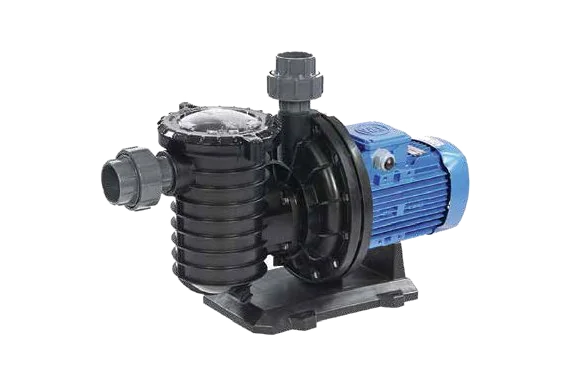
Choosing a pool pump often starts with the question, “How many horsepower should it be?”—but the right question is actually: How long do I want it to take to circulate all the water in the pool through the filter? Motor power is the result of this calculation—not the starting point.
In this guide, we size a pool pump in three steps: turnover time → flow rate → total head; then we address filter compatibility and energy efficiency.
Next, we’ll cover what the regulations say, safety requirements, winter preparation, and common on-site malfunctions. If you’re experiencing issues with an operational pool, you can skip directly to the troubleshooting chart.
Step 1 — Turnover time
The turnover time is the time required for all the water in the pool to pass through the filter once. Standard practice:
As the turnover time decreases, water quality improves, but the pump and filter become larger.
What does the law say?
Health requirements for swimming pools in Turkey are regulated by the Ministry of Health’s Regulation on Health Principles and Conditions Applicable to Swimming Pools (Official Gazette: March 6, 2011, No. 27866; amendments have been made at later dates). The regulation defines the recirculation time as “the time required for the total pool volume to pass through the filtration system once” and specifies the requirements regarding the quality of pool water, as well as the frequency of sampling and analysis.
Practical conclusion: In pools operated for commercial purposes, the turnover time is not a matter of preference but a regulatory requirement. Residential/complex pools and public facilities are not sized using the same calculation. Designs must be based on the current text of the applicable regulation, and the frequency of analyses required during inspections must be specified in the operating plan. Thermal spa pools used for health purposes and non-commercial pools are outside the scope of the regulation.
Step 2 — Required flow rate
Flow Rate (m³/hour) = Pool Volume (m³) ÷ Turnover Time (hours)
Example: A pool measuring 8 m × 4 m with an average depth of 1.5 m:
If the pool is not a regular prism (variable depth, free-form), calculate its volume by dividing it into sections. For pools with overflow channels, the volume of the balancing tank must also be taken into account.
Step 3 — Total head (TDH)
This is the step that is most often overlooked and leads to the most errors. The "12 m³/h" value in the catalog applies to a specific head. The pump does not produce a single value, but rather a curve: as the back pressure increases, the flow rate decreases.
The total head is the sum of the following items:
The correct choice is to select a point on the pump curve where the TDH—calculated based on the target flow rate—intersects the curve. This point should be close to the center of the pump’s efficiency band.
Filter compatibility: Select a pump based on the filter
Sand filters have a surface velocity limit: the maximum flow rate that can pass through a unit area of the filter. When the pump delivers water at a rate exceeding this limit:
Rule: The filter’s nominal flow rate must be equal to or greater than the pump’s operating flow rate. The assumption that “a more powerful pump means a cleaner pool” is incorrect; a pump that is too large for the filter impairs filtration.
Adequate flow rate is also required for backwashing; the filter and pump must be selected together.
Suction system and pre-filter
Pool pumps are typically equipped with a pre-filter basket and are self-priming; they trap coarse debris such as leaves and hair. Regular cleaning of the basket is the easiest way to prevent a decrease in flow rate.
If the pump is above the water level, it will have to perform suction lift, creating a risk of cavitation—especially in long suction lines and on hot days. Position the pump as close to the water level as possible and within a short distance of the system. For more information on the physics behind this, see our NPSH and cavitation guide.
Another common problem with self-priming pool pumps is the inability to prime. The pump casing must be filled with water during the initial startup and after every pre-filter cleaning; running the pump with an empty casing will burn out the mechanical seal within seconds. Other common causes of failure to prime include: a dried-out or improperly seated pre-filter cover gasket (this gasket is on the suction side; if it leaks, water does not flow out, but air is drawn in) and the skimmer level dropping low enough to draw in air.
Pipe diameter: the silent constraint that determines flow rate
The most common mistake in pool plumbing is upgrading the pool pump while leaving the piping as is. As the water velocity inside the pipe increases, friction loss increases proportionally to the square of the velocity; past a certain point, a more powerful pool pump does not produce a higher flow rate, but only a higher electricity bill.
Speed limits in swimming pool facilities:
The flow rate a pipe can carry: Q (m³/hour) = cross-sectional area (m²) × velocity (m/s) × 3600. For example, in a pipe with an inner diameter of 50 mm, the cross-sectional area is 0.00196 m²; at a flow velocity of 1.5 m/s, the flow rate it can carry is ≈ 10.6 m³/hour. In a system designed for 16 m³/h, this pipe would be insufficient for suction, and a larger diameter pipe would be required.
Rule: The suction pipe should always be one size larger than the discharge pipe.
Safety: Suction Inlet and Risk of Clogging
In pool plumbing, the suction side is not just a hydraulic issue—it’s also a safety concern. A single bottom suction inlet creates a significant vacuum when covered and can lead to entrapment accidents.
In public swimming pools, this matter is governed by current regulations; the relevant regulations must be followed during the design phase.
The second aspect of safety is the electrical system. The area around the pool is considered a wet area in terms of electrical safety: a ground-fault circuit interrupter (GFCI) must be installed on the pump supply line, the motor casing and metal components must be grounded via an equipotential bonding connection, and the pump room must be equipped with drainage to prevent water accumulation. These requirements are not part of the pump selection process but are an integral part of the commissioning process.
Energy: Why Does Variable Speed Pay Off?
The laws of affinity apply to centrifugal pumps:
Interpret the result as follows: if you cut the turnover time in half, the flow rate is halved, but power consumption drops to one-eighth. To filter the same volume, you’ll need to double the turnover time; power consumption will still drop to roughly one-fourth.
For this reason, running the pump at low speed for a long time is significantly more economical than running it at high speed for a short time—and filtration quality also improves at low speeds. Variable-speed (variable frequency drive) pool pumps have therefore become widespread.
To see the difference in numbers, let’s go back to our 48 m³ pool. There are two ways to filter the same volume:
| Operating Mode | Flow Rate | Duration | Relative power (affinity) | Relative energy |
|---|---|---|---|---|
| Full cycle | 12 m³/h | 4 hours | 1.00 | 1.00 |
| 75% speed | 9 m³/h | 5.3 hours | 0.42 | 0.56 |
| 50% speed | 6 m³/h | 8 hours | 0.125 | 0.25 |
These values are merely relative quantities derived from the laws of affinity; actual savings are reduced somewhat by motor and drive efficiency, as well as the system’s static head. Nevertheless, the trend is clear: reducing the speed and extending the duration achieves the same filtration with significantly less energy.
There are two limits. The flow rate should not be reduced to the point where the skimmer can no longer clean the surface, and it should not fall below the minimum flow rate required by equipment such as the salt chlorine generator and heat pump. A common practical solution is to run at high speed for sweeping and heating during part of the day, and at low speed for filtration during the remaining time.
Preparing for Winter and Frost Protection
The most common time for a pool pump to fail is at the end of the season. In a system that will not be used during the winter, the pump casing, filter, and pipes must be drained: if the water left inside freezes, the casing will crack, and this damage is irreparable. To prevent the mechanical seal from drying out and sticking, the pump should be manually rotated to check for smooth operation before the first startup at the beginning of the season. If the system is to remain in operation during the winter, circulation must be maintained or the machine room must be heated to prevent the risk of freezing.
Materials and Water Chemistry
Our chemical compatibility guide provides guidance on material selection.
From Symptom to Cause: Diagnosing Pool Plumbing Issues
| Symptom | Possible cause | Initial Check |
|---|---|---|
| The pump is running, but no water is being pumped | Failed to prime; air in the suction line | Fill the casing with water; pre-filter cover gasket; water level |
| Air bubbles in the pre-filter basket | Air leak on the suction side | Cover gasket, suction fittings, skimmer level |
| Flow rate has decreased over time | The pre-filter or sand filter is clogged | Clean the basket; check the filter pressure gauge—it’s time for backwashing |
| The pool is cloudy, but the filter appears to be running | The pump is too large for the filter — surface velocity exceeded | Is the filter’s nominal flow rate ≥ the pump’s flow rate? |
| The pump is noisy, making a gravel-like sound | Cavitation — restricted suction lift | Suction diameter and length; water level; NPSH |
| Leakage from the mechanical seal | The mechanical seal is worn or has experienced dry running | History of dry running; mechanical seal assembly |
| Motor is overheating, tripping thermal protection | Duty point outside the curve; insufficient ventilation | Actual TDH; engine ventilation ducts |
| Sand is escaping during backwash | High surface velocity or broken diffuser/collector | Flow rate; filter internals |
| The casing cracked as winter set in | Frozen water | End-of-season drainage procedure |
Example: From start to finish
Pool: 10 × 5 m, average depth 1.6 m · Circulation target: 5 hours · Equipment: sand filter + heat pump
Checklist
Frequently Asked Questions
How many hours should a pool pump run?
The right question isn’t “how many hours,” but rather how many times a day the pool’s volume passes through the filter. For residential pools, the standard practice is a turnover time of 4–6 hours; for commercial pools, the duration is determined by applicable health regulations. With a variable-speed pump, the cycle time increases, yet energy consumption decreases.
Does a more powerful pool pump mean a cleaner pool?
No. The filter has a surface velocity limit; when the pump exceeds this limit, the water passes through the sand bed too quickly and is not filtered sufficiently. A pump that is too large for the filter will leave the pool cloudier and also consume more electricity.
Does a variable-speed pump really save money?
Yes, because power varies with the cube of the flow rate. Halving the circulation rate reduces the power consumption to one-eighth; even if the time required to filter the same volume doubles, the net power consumption drops to roughly one-fourth. Limitations: the skimmer’s surface cleaning capacity and the minimum flow rate of equipment such as the salt chlorinator or heat pump.
The pump isn't priming. What should I do?
First, fill the casing with water. If the problem persists, check for air leaks on the suction side: the front filter cover gasket, suction fittings, and skimmer water level are the most common causes. If the suction line is long and narrow, or if the pump is located well above the water level, a permanent solution involves adjusting the plumbing layout.
Which pool pump should be used in a saltwater (salt-chlorine generator) pool?
In a pool equipped with a salt chlorine generator, the water contains chloride, which increases the risk of corrosion. Pumps with thermoplastic casings and appropriate grades of stainless steel are preferred; standard 304-grade stainless steel may not be sufficient for this environment. For more details, refer to the chemical compatibility guide.
If you share your pool dimensions and plumbing details, we can work together to determine the appropriate flow rate and model. You can browse the Storm, Florida Atlaspool, and Best series in our pool pumps category, or get in touch with us.